New AI technology is becoming so sophisticated, writes contributor Molly McKinley, that consumers may not recognize what’s real or fake. This is a red flag for agents.
Inman Connect
 Invest in yourself, grow your business—real estate’s biggest moment is in San Diego!
You already know that referrals are different. The conversation is easier. The skepticism is lower. The closing rate is higher. What you may not have considered is why this matters more now than at any point in real estate history.
Many agents are using AI to improve or hack their business profiles so they can reach more folks, with less effort, but with this adaptation, are we losing the human connection?
In this article, I will share information about new AI technologies and how these technologies can wow, but also create tangible issues for consumers as the line between reality and AI becomes more blurred. What does this mean for agents? That word of mouth, or warm referrals, becomes even more valuable to your bottom line.
New AI visuals: Seeing is not believing
On Oct. 30, 2025, OpenAI released Sora 2, a tool that creates hyper-realistic video from text prompts. Within five days, more than one million people downloaded it. Three weeks later, Google launched Nano Banana Pro, an image-generation model that creates studio-quality visuals with accurate text rendering across multiple languages.
A political scientist at NYU captured the moment when he told researchers, “I think we might be in the era where seeing is not believing.”
That phrase should stop you cold. For centuries, visual evidence was the final arbiter of truth. Now, when we encounter content online, the first question is no longer “what does this show?” but “is this even real?”
The mathematics of overwhelm
This collapse of visual certainty arrives when humans are already overwhelmed. According to Lunio research, the average person now encounters between 6,000 and 10,000 advertisements daily. In the 1970s, that number was 500 to 1,600.
Meanwhile, our processing capacity has moved in the opposite direction. Dr. Gloria Mark at UC Irvine has tracked attention spans for two decades. In a 2023 interview, she reported that in 2004, people averaged 2.5 minutes on any screen before switching. Today it has fallen to 47 seconds. The median is 40 seconds.
Six times more messages are competing for one-third of the attention. The traditional model assumed visibility leads to consideration. That model is breaking.
Recognized vs. known
Consider the paradox of real estate reality television. These shows have made agents more visible than ever. Millions watch weekly. Familiarity, after all, breeds trust.
Yet something strange is happening. The medium that creates familiarity is simultaneously eroding professional credibility. The shows rarely depict actual work: market analysis, contract expertise, negotiation strategy, fiduciary responsibility. Viewers see personality and drama. The agent becomes familiar as a character, invisible as a professional.
This is the difference between being recognized and being known. Recognition comes from exposure. Being known requires that someone understand what you actually do, trust your judgment and believe you have their interests at heart. Recognition happens to you. Being known happens through you, one relationship at a time.
This explains why an agent with 50,000 social media followers can struggle while an agent who has never posted closes deal after deal through referrals. Visibility is not credibility. Familiarity is no longer trust.
The referral as proof
There is precisely one mechanism that bypasses the skepticism loop. When someone I already trust tells me to trust you, your credibility borrows from theirs. According to Nielsen, 92 percent of consumers trust word-of-mouth recommendations more than any other form of advertising.
The referral works because it is not a claim. It is testimony. The person making the recommendation has experienced your competence directly. They observed your integrity over time. They stake their own credibility on you. In an environment where all other forms of proof are suspect, the referral becomes the last reliable signal.
What digital presence actually does
This does not mean abandoning your online presence. Digital visibility provides social proof that you exist. It gives referred prospects a way to learn about you. It confirms what a referral has already established.
The shift is in the order of operations. In the old model, digital presence was the engine. You attracted strangers through content and converted them into leads.
In the Trust Economy, the relationship comes first. Someone who knows you introduces you to someone they know. Your digital presence then confirms what the referral established. The funnel starts narrow with one trusted relationship and widens through networks of trust.
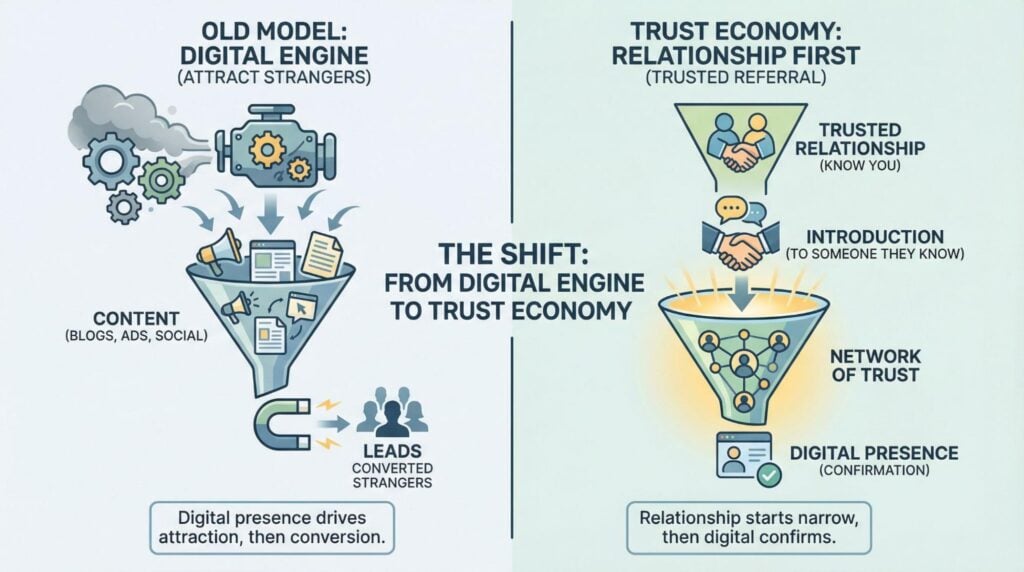
Created by Molly McKinley using Artlist
A November 2025 World Economic Forum study found that 73 percent of consumers actively avoid businesses that do not demonstrate genuine care. The same research found that 71 percent believe AI cannot create an authentic human connection. People are developing sharper instincts for what is genuine.
The question for 2026
We are entering a period when the tools that once built businesses will grow less effective. Advertising will fight for attention that does not exist. Content will struggle to be believed. Visual evidence will carry less weight than a word from a friend.
The question worth sitting with: When someone in your market needs an agent and asks a friend for a recommendation, does your name come up? Not because you are visible. Not because you are familiar. But because someone who has experienced your work trusts you enough to stake their own credibility on the referral.
Ensuring the answer is a “Yes” should be the focus of your 2026 strategic plan.
Molly McKinley is a professor of Entrepreneurship, Innovation, and Social Impact at Meredith College in Raleigh, North Carolina, and founder of Redtail Creative.
Topics: agent safety | lead generation Show Comments Hide Comments Sign up for Inman’s Morning Headlines What you need to know to start your day with all the latest industry developments Sign me up By submitting your email address, you agree to receive marketing emails from Inman. Success! Thank you for subscribing to Morning Headlines. Read Next How AI is transforming the role of real estate reviews
 How real estate pros can thrive beyond the MLS in the AI era
 AI is reshaping search, but these old-school trust signals still win
 These 2 AI changes are poised to impact your real estate business
More in Marketing
These 2 AI changes are poised to impact your real estate business
More in Marketing
 7 AI prompts that will help real estate agents win big in 2026
 How Netflix, Disney and OpenAI are redefining control online
 Why your real estate email campaigns aren’t converting (yet)
 $200K per year by Year 3: From part-time agent to powerhouse
Read next
Read Next
How real estate pros can thrive beyond the MLS in the AI era
These 2 AI changes are poised to impact your real estate business
 Why 2026 will reward those who plan with precision, not emotion: Mauricio Umansky
 Delistings and discounts jump as holiday season approaches