The application uses sharp user interface design and AI to shrink data input and offer inspectors a number of ways to complete reports in less time, tech expert Craig Rowe writes.
Binsr Inspect is a mobile and web-based home inspection application. It has a separate app for in-field report execution and work management with an offline work mode and voice input function that allows inspectors to not worry about bandwidth when twisted behind a water heater in a strange ZIP code.
It is designed to make ordering, conducting, and processing an inspection faster and more integrated with the parties of the transaction. It relies heavily on AI to interpret photos, translate voice item descriptions, automatically place comments for verification or editing, and expedite other steps in the workflow for inspectors.
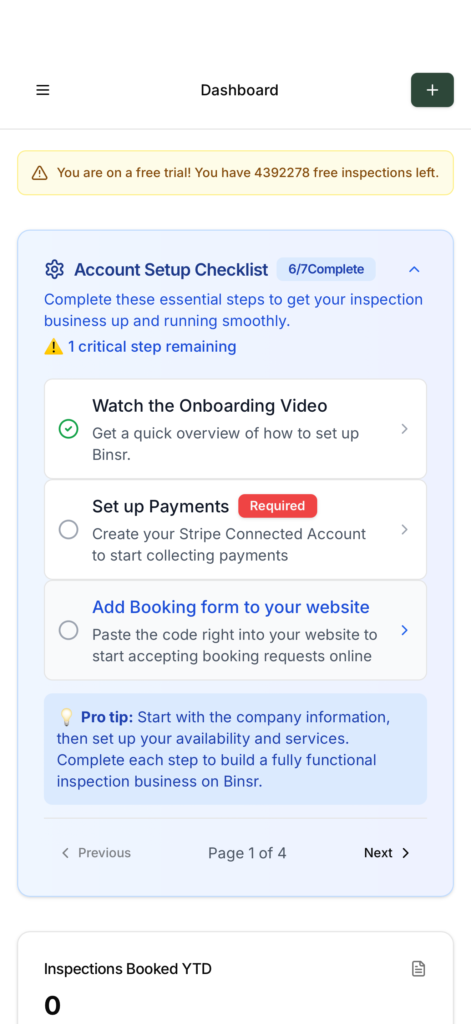
It can involve all stakeholders by connecting calendars and facilitating communications, uses templates to initiate inspections, and processes payments using Stripe. It’s customizable by state as needed and designed to be used in the field.
Highlights
- AI task execution
- Voice prompt translation
- Saved, auto-placed comments for common items
- Mobile-first UX ready for the field
- On-board invoicing
- Separate report creation app with offline mode
Company summary
Arizona-based Binsr Inspect was founded in 2023 by Mark Garcia and Aryash Dubey. It recently closed a pre-seed round of a little over a $1 million led by New Stack Ventures and Silence VC.
Interestingly, Lofty founder Joe Chen had a hand in it, too. Chen is no stranger to using AI in real estate workflows and is clearly familiar with what it takes to find traction in real estate. That doesn’t guarantee anything, but should provide anecdotal confidence in Binsr’s status.
Its name is kind of a clever acronym: Buyer’s Inspection Notice and Seller’s Response, the document used in Arizona for post-inspection repair negotiation and with irony not lost, it’s at that stage where most real estate deals tend to go off the rails.
The company evolved from a previous company that the founders created, which essentially functioned like Thumbtack. Home repair, meet vendor.
However, after a trend emerged of agents asking them to examine extensive home inspection reports, the duo discovered a more pressing need, as well as the value AI offers in understanding stacks of paperwork faster than humans. That company, Binsr AI, still exists, but to quote Garcia, “That’s a feature, not an application.”
The company is small, employing three people as of this writing, but is actively hiring with plans to “double in size” within six months. It was not clear what business metric it’s aiming to double. The company is in beta as of now, according to Garcia, with more than 700 companies on its waitlist.
Less tapping, more inspecting
Each feature I saw in Binsr appears to be benchmarked against the primary goal of helping inspectors complete a project faster. It’s really that basic in concept, but much more advanced in its execution.
Ranging from the AI-driven translation of spreadsheets into Binsr templates to the intrinsic agreement review and e-sign engine, the company’s approach reminds me of the writing process. Chisel off a bit here, refine there.
This is a true productivity app that doesn’t leave out any of the stakeholders, nor does it offer many opportunities for them to ask for something else.
Binsr told me that its primary report template was actually licensed from an inspector they consulted about the product, which I feel adds to the grassroots nature of its creation.
Thus, Binsr isn’t trying to be an evolutionary, esoteric endeavor that’s more automated than it needs to be. It knows that it’s supposed to be software, a tool to make a job easier to perform. Its AI targets the report process, not the person doing the reporting.
“We see the inspection as a huge source of data that’s trapped in PDFs, and we want to free that for homeowners to do some really cool things with it downstream,” Garcia told me, a comment that sent off some alarm bells during our demo. I don’t want to see what I consider a super-tight application for inspectors wade into the home management/service provider marketplace. “All that is down the road, much later, like in our Phase three,” he said.
I’m not sure my cynicism about that category matters to him, or that it should. He’s right about home inspections containing eons of trapped industry data, and that there’s untold value in leveraging it, like a rare earth mineral. Given my impression of Garcia and what his team has built to date, I owe them space to move.
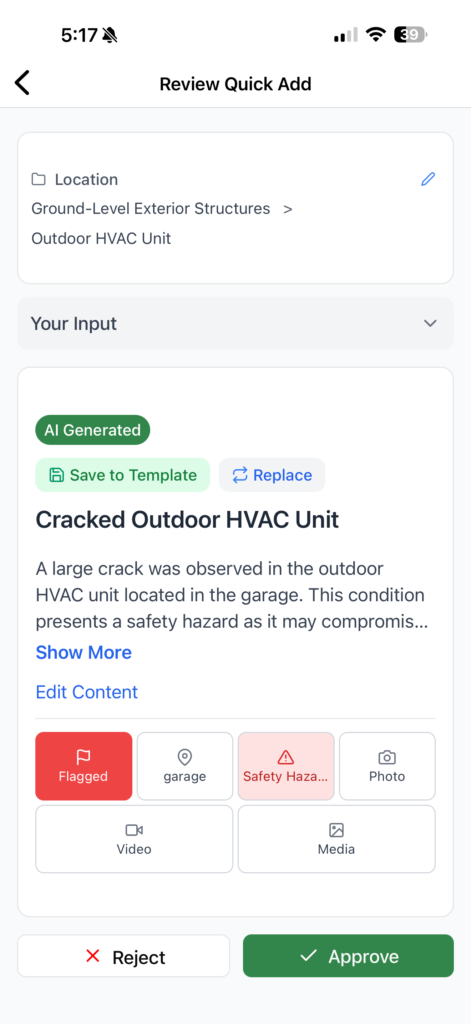
Binsr Inspect’s reports are sharp, color-coded drop-downs that identify items and pre-load comments, which can, of course, be refined manually if needed. But a lot of houses have the same problems and demand the same descriptions, so why not have them ready to go?
Better yet, the comments can become standardized, which will help set precedents in how buyers react to certain items. There’s always too much hyperbolic fear associated with the realization that a house isn’t physically perfect.
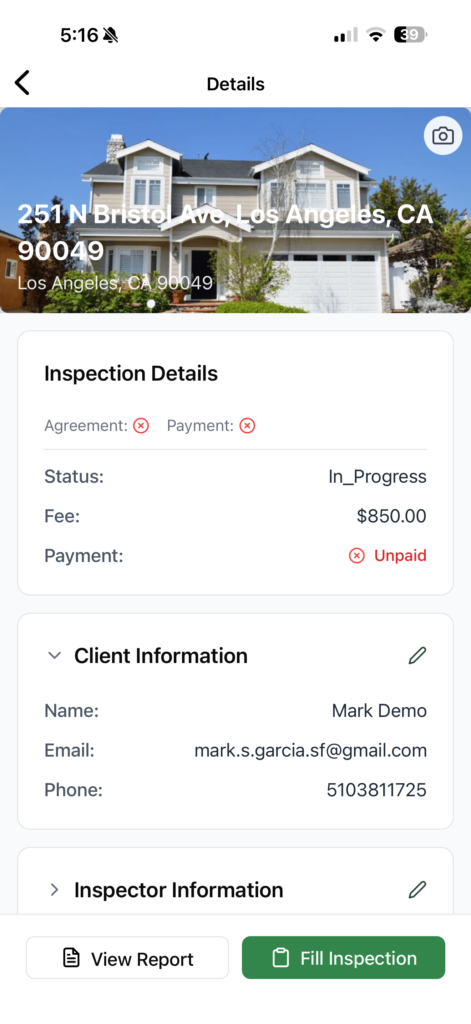
The Binsr Report Builder app, used in conjunction with Inspect, is the practitioner’s field tool. It receives requests, launches new inspections, tracks progress of completed inspections, facilitates payments, schedules and even provides directions to the next job. Its primary role is to be their input device, to reduce what Garcia called “human motions.”
”We want less tapping, more inspecting,” he said. “We watched a lot of inspectors in other apps basically do the tap Olympics.”
The app uses typical inspection section titles on its report experiences and deploys abbreviated icons to indicate status, such as an I for “Inspected” and NP for “Not present.” The AI will create a more descriptive comment based on a short voice prompt so the inspector isn’t merely thumbing their way through each day.
The app can add photos, accept image highlights and graphical edits, and also capture video and other media to illustrate concerns. Naturally, all the photos will carry over to the desktop version to accompany each item description.
This is the second AI-heavy inspection application I’ve reviewed this fall, proving to me that AI is rightly coming for the heavily manual, momentum-killing aspects of the real estate transaction. It can help inspectors do more in less time without threatening their trade with obsolescence.
Binsr Inspect is one to watch, and I hope it gets the right relationships in place to scale. On that note, it will no doubt benefit from launching in the Phoenix-Scottsdale market, where it can learn quickly from the capital of architectural redundancy.
Have a technology product you would like to discuss? Email Craig Rowe
Craig C. Rowe has been writing software reviews for Inman since 2015. He started in commercial real estate at the dawn of the dot-com boom, helping an array of commercial real estate companies fortify their online presence and analyze internal software decisions. He consults with residential brokerages and agents on technology decisions and marketing and helps Inman readers understand the ever-evolving landscape of proptech.
Show Comments Hide Comments

